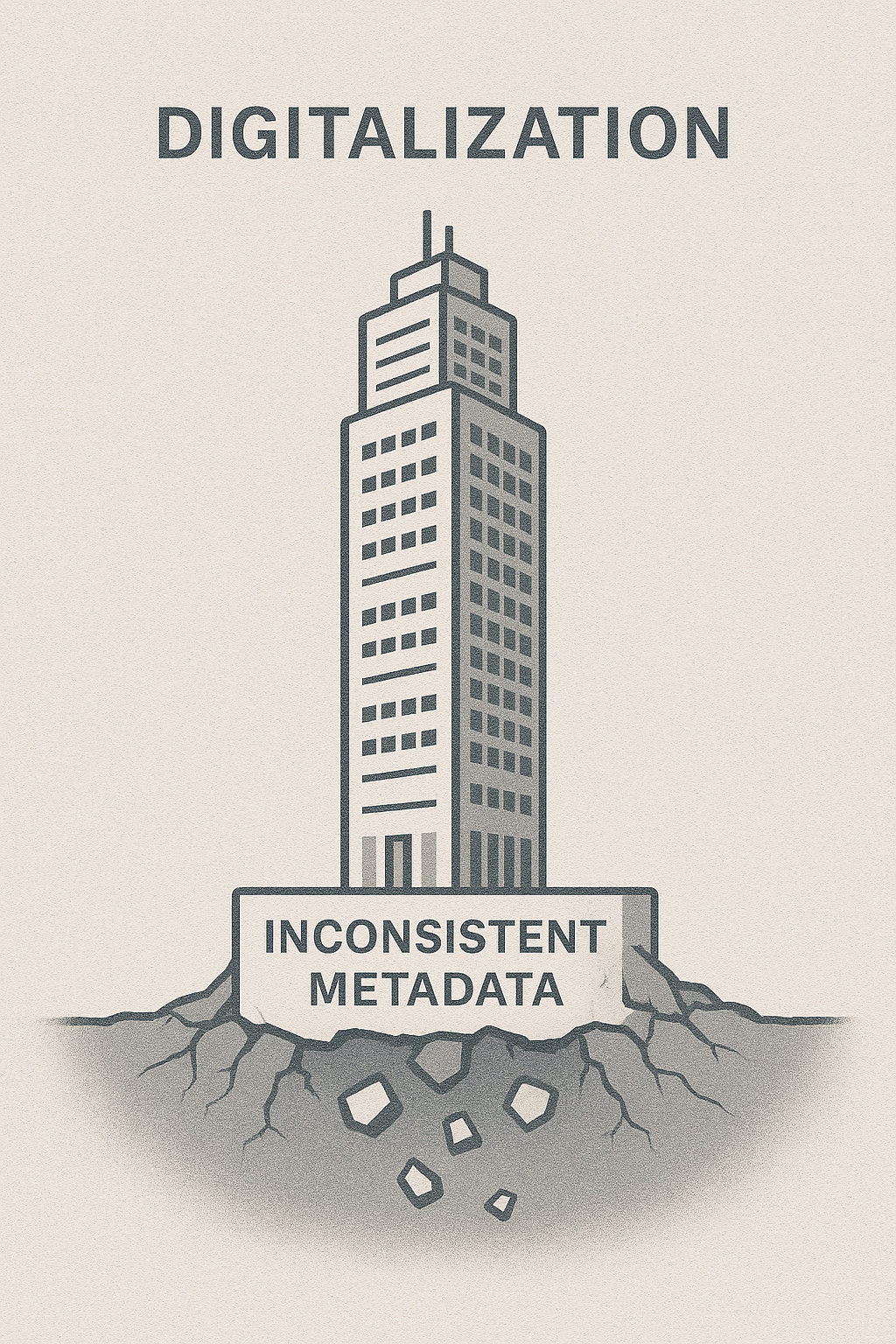
Why Digitalization in Solar Often Fails Before It Even Starts
Digitalization projects in solar portfolios often begin with noble intentions:
- "We need advanced analytics."
- "We need a unified dashboard."
- "We want automated reporting."
- "We want AI-driven insights."
- "We want self-service analytics."
Yet most initiatives fail quietly. Not because the algorithms are wrong, but because the foundation underneath the analytics is unstable.
This foundation is the plant's technical information - the layer described in Why Technical Plant Information Is the Missing Link in Solar Operations.
The Core Problem: Digitalization Starts at the Wrong Layer
Most digitalization projects begin with:
- dashboards
- analytics engines
- BI tools
- Python pipelines
- machine learning models
These are "top-floor" systems. But the "ground floor" - consistent technical metadata - is missing.
Example
You cannot build:
- stable KPIs
- reliable baselines
- comparable benchmarks
...without consistent:
- capacities
- topologies
- inverter mappings
- component histories
Analytics built on shifting metadata produce shifting insights.
Why Solar Digitalization Breaks Down
1. Metadata is incomplete or inconsistent
Capacities differ by portal. Naming varies by site. Topology is unclear.
See: Technical Information Consistency (coming soon).
2. Changes are not tracked
Digitalization assumes a stable plant model, but plants evolve constantly.
3. Workflows remain manual
If updates aren't recorded at the source, digital systems cannot stay synchronized.
4. Teams rely on spreadsheets as the real source of truth
Digital systems replicate inconsistent inputs.
5. Monitoring providers cannot fill the gaps
Monitoring platforms expose performance; they do not maintain configuration history.
See: Why Monitoring Systems Can't Track Everything (coming soon).
How Digitalization Can Succeed Instead
1. Stabilize technical information first
Digitalization requires consistent:
- capacities
- component lists
- mappings
- change history
2. Define a clear metadata baseline for each site
Everything builds on this baseline.
3. Align naming conventions across the portfolio
This eliminates the largest source of drift.
4. Treat metadata corrections as shared assets
When one system is corrected, all systems should adopt the update.
5. Digitize change tracking
Even minimal documentation dramatically improves analytical reliability.
See also
- The Case for Treating Technical Information as First-Class Solar Data
- Solar Asset Documentation Is Broken - Here's What Operators Can Do Today
- Technical Information Consistency (coming soon)