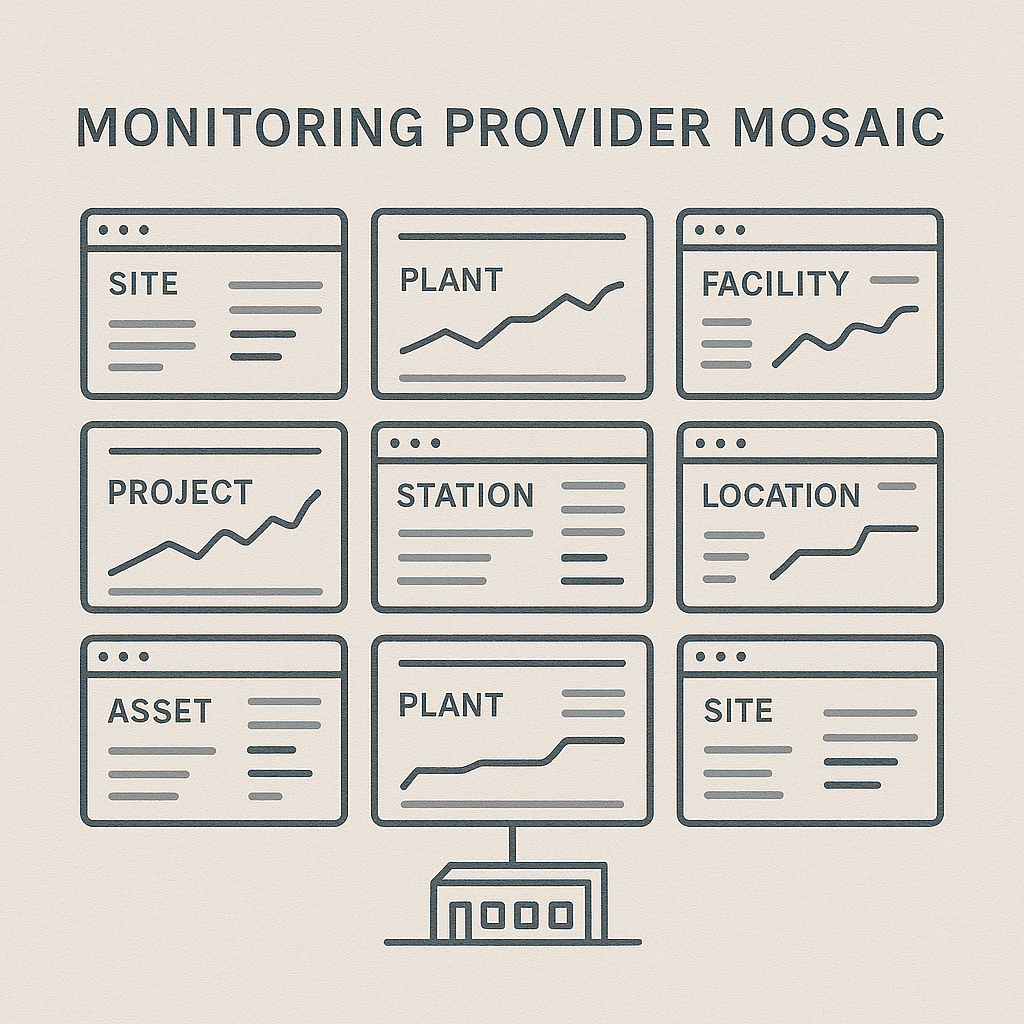
The Hidden Costs of PV Data Fragmentation Across Monitoring Providers
Most operators think fragmentation is an inconvenience. In reality, it's one of the largest hidden operational costs in solar portfolios.
Fragmentation isn't only about having multiple logins. It's about:
- different metadata models
- mismatched naming conventions
- inconsistent capacity fields
- incompatible inverter numbering
- differing file formats
- varied assumptions in KPI calculations
This fragmentation becomes structural overhead. And that overhead compounds as portfolios grow.
This topic connects directly with Multi-Monitoring Complexity.
Why Fragmentation Matters More Than Most Teams Realize
At first, multiple systems seem manageable. But under the surface, fragmentation impacts:
1. Normalization
AC capacity in one system isn't AC capacity in another. Nominal power fields differ. Correction factors vary.
2. Naming conventions
One provider uses "INV03," another "3_Inv," another "Inverter-West-3."
3. KPI definitions
Even simple metrics like PR differ across portals.
4. Metadata completeness
Some portals include string-level details. Others provide barely anything.
5. Export structures
CSV, XLSX, TSV, JSON, API variations - all different.
The result is operational friction. Every analysis starts by reconstructing context.
How Fragmentation Creates Hidden Costs
1. Manual cross-system alignment
Analysts manually map:
- inverter lists
- transformer allocations
- MPPT structures
- capacity fields
- naming conventions
Hours disappear before analysis even begins.
2. Divergent truths emerge
Correction made in one system never reaches the others. Teams unknowingly operate with conflicting assumptions.
3. Investigations slow down
Each incident requires cross-checking:
- monitoring portal
- OEM interface
- SCADA exports
- spreadsheets
- historical screenshots
See: Why Solar Performance Investigations Take Longer Than They Should (coming soon).
4. KPI drift is amplified
Drift becomes harder to detect when KPIs differ by provider.
See: KPI Drift in Solar Assets: The Silent Risk No Monitoring System Warns You About.
The Portfolio-Scale Effect
The larger the portfolio, the more monitoring systems appear:
- Portal 1 for the legacy sites
- Portal 2 for EPC A
- Portal 3 for EPC B
- Portal 4 for repowered sites
- OEM-level tools for certain inverters
Each new site introduces variation. Each variation introduces alignment work.
This compounds into:
- slower reporting cycles
- inconsistent executive summaries
- higher overhead for audits
- less trust in analytics across teams
What Operators Can Do Today
1. Maintain a unified naming scheme
Even if the systems differ, your internal naming can stay consistent.
2. Normalize capacity fields across providers
Create a single definition for DC and AC capacity and enforce it.
3. Track system-specific quirks
Keep a record of each monitoring provider's metadata limitations.
4. Reconcile corrections centrally
When something is fixed in one system, reflect it elsewhere.
See also
- Multi-Monitoring Complexity (coming soon)
- Technical Information Consistency (coming soon)
- KPI Drift in Solar Assets: The Silent Risk No Monitoring System Warns You About