Checking the Availability in an O&M Report: What It Takes
In an O&M contract, availability decides liquidated damages. What it takes to recompute the reported number from the raw readings, explain the difference, and get a number both owner and contractor can check.
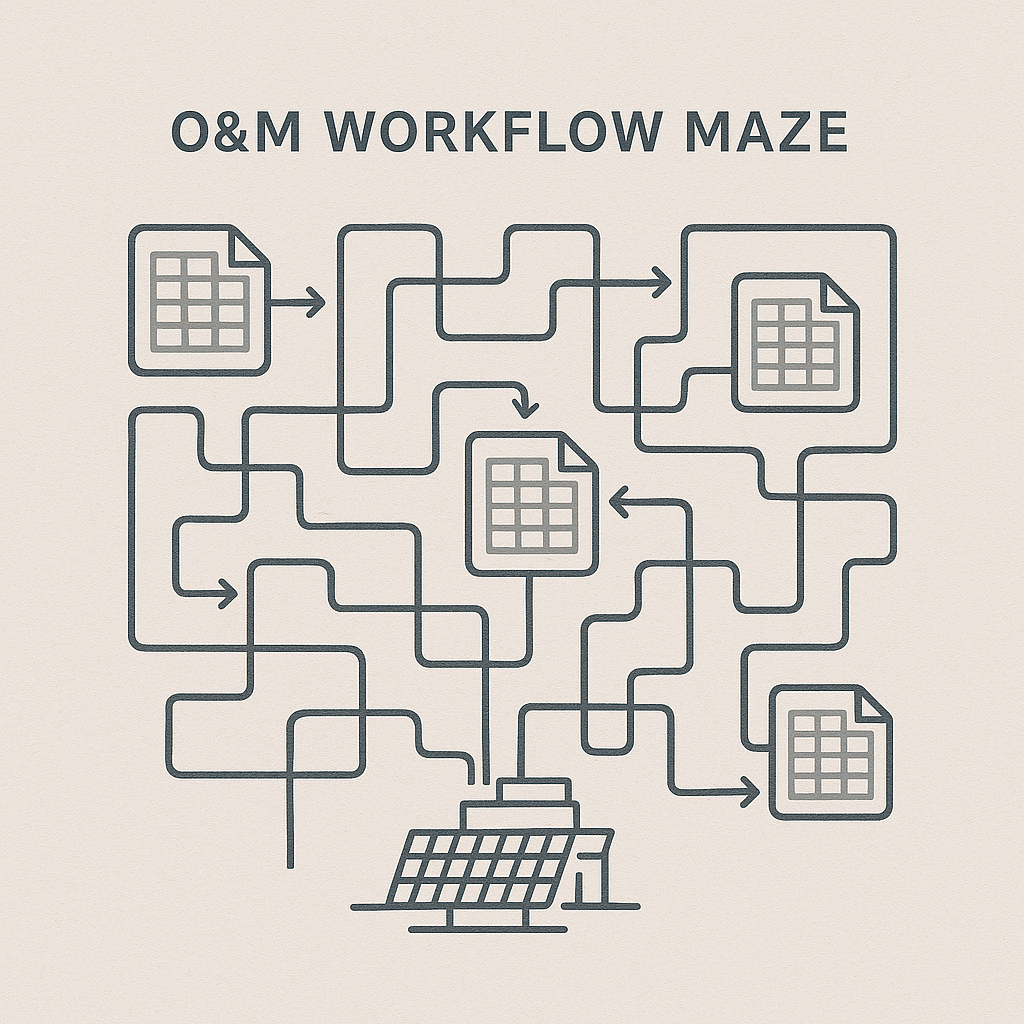
The O&M contract guarantees 98 % availability. Below that, the contractor pays liquidated damages. Every month a report states the number, and the owner signs it off.
The number usually comes out of the portal or the contractor's own system, with rules that live partly in the contract and partly in software. The owner sees a result. The contractor is paid on it. Both are better off with a number either of them can recompute.
What one month can look like
Synthetic example. The numbers are made up, the mechanics are not.
A plant with ten inverters of equal size and 300 daylight hours in the month. The grid operator disconnected the plant for 2 hours, which the contract excludes. Inverter 3 had a fault for 42 hours. Inverter 7 was stopped for 21 hours of maintenance that was not on the maintenance plan. The data logger was silent for 3 hours.
| Reported | Recomputed with the contract's rules | |
|---|---|---|
| Grid outage, 2 hours | Excluded | Excluded |
| Maintenance on inverter 7, 21 hours | Excluded | Unavailable: the contract excludes only maintenance announced a week ahead |
| Data logger silent, 3 hours | Counted as available | Unknown: left out, and reported next to the number |
| Availability | 98.6 % | 97.9 %, 1.0 % unknown |
The guarantee is 98 %. One number passes, the other does not.
Almost the whole difference comes from the maintenance hours. Counting the silent hours as available instead of unknown moves the number by less than 0.1 points here. It still matters: for those 3 hours, nobody can say whether the plant ran.
Who is right is a question for the contract, not for the data. If the maintenance was agreed by phone, the exclusion may well be fair. The check doesn't decide that. It shows which 21 hours the question is about.
Why the reported number is hard to check
- The rules are in two places. The contract says what is excluded, in prose. The system applies its own reading of it, in code. Neither is written next to the number.
- The raw readings are in the portal. Recomputing needs every inverter, every interval, for the whole month. The monthly figure alone can't be checked.
- Exclusions are applied by hand. Grid outages, maintenance windows and curtailment often come from emails and plans and are entered in a spreadsheet. That is a sensible tool for the job. But the rule ends up in a cell formula, and a correction overwrites the value it corrects.
- Each contract is different. A contractor with thirty plants may have thirty exclusion lists, while the portal computes one availability. See Twelve Solar Plants, Three Portals.
Doing it yourself
- Turn the availability clause into written rules: which hours count, for example irradiance above a threshold, how inverters are weighted, what a data gap is, what is excluded and under which conditions, and what counts as unavailable. Our availability definitions can serve as a start. Agree the rules with the other side once.
- Get the raw readings for the month at full resolution, per inverter, and the list of events: grid outages, the maintenance plan, curtailment.
- Classify every interval of every inverter: available, unavailable, excluded with its reason, or unknown.
- Add it up, weighted as the contract says, and report the unknown share next to the number.
- Compare with the reported number and test which choices reproduce it. In the example, excluding the maintenance and counting the silent hours as available gives exactly 98.6 %. Both choices are confirmed, and nothing stays open.
- Keep the inputs. A dispute about a month often starts months later.
The first month takes the longest. After that it is routine, as long as the raw data keeps coming.
If you are the O&M contractor, the same check is how you show what you delivered: every excluded interval with its reason, every gap named. See our page for O&M contractors.
Or let us do it
Send us one plant and one month. We recompute technical and contractual availability from your raw readings, with the rules written down together with you, and show the difference against each reported number: which choices explain it, and what stays open. We check the numbers. Whether an exclusion was fair stays your call.
See also
Read next
Send one plant, one month.
You get performance ratio and availability as a base row with the rules written down, the difference against each reported number with what explains it and what stays open, a method card next to every number and a 30-minute walkthrough. Nothing changes in your monitoring.
Send one plant, one month