Why O&M Teams Still Depend on Spreadsheets and How It Hurts Solar Performance
Every O&M team relies on spreadsheets. Not because they prefer them, but because spreadsheets fill the gaps left by monitoring portals, EPC documentation, and change logs.
Spreadsheets are the connective tissue of solar operations-but also the source of silent inconsistencies.
This topic intersects with How Portfolio Growth Exposes Hidden Weaknesses in Solar Data Management.
Why Spreadsheets Dominate O&M Workflows
1. They adapt faster than systems
When something changes-string count, inverter mapping-spreadsheets update instantly.
2. They serve as temporary memory
Teams use spreadsheets to track tasks, anomalies, expected vs. actual behavior, and equipment configurations.
3. They support ad-hoc analysis
Monitoring systems provide dashboards. Spreadsheets support logic, "if-then" checks, and investigative calculations.
4. They hold undocumented corrections
When metadata is wrong in a portal, teams fix it locally-in spreadsheets.
Over time, what began as a workaround becomes the system-of-record.
How Spreadsheet Reliance Hurts Operational Stability
1. Information diverges
Every analyst copies sheets, makes edits, or adds corrections. Multiple versions emerge.
2. Corrections never reach the source
Fixes made locally never update the monitoring system or documentation.
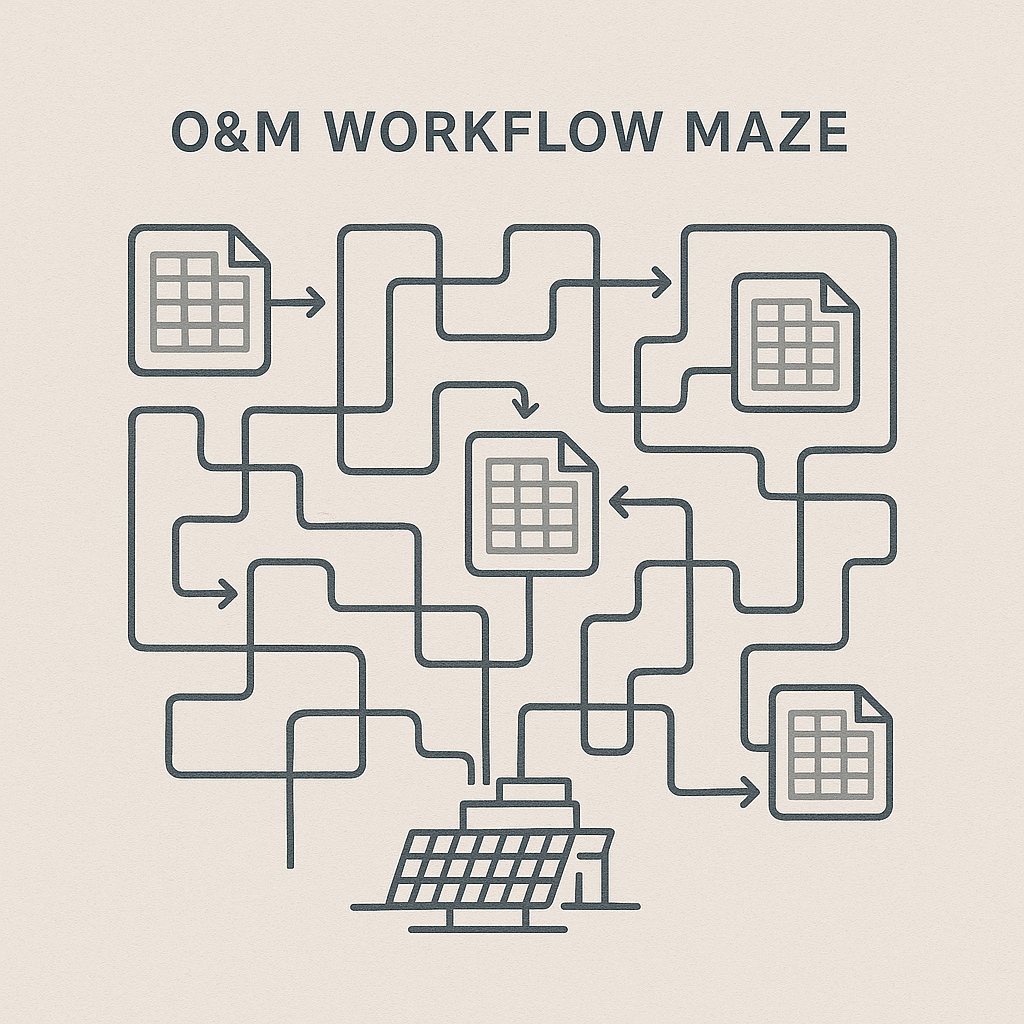
3. Investigations become multi-file archaeology
Teams search across:
- spreadsheet snapshots
- exported CSVs
- manually corrected tables
- pivot tables
- personal versions
4. Baselines drift silently
If one spreadsheet uses updated capacity and another doesn't, KPIs become incomparable.
See: KPI Drift in Solar Assets: The Silent Risk No Monitoring System Warns You About
5. Portfolio growth multiplies inconsistencies
What works for five plants collapses at fifty.
Why Spreadsheets Weaponize Tribal Knowledge
Spreadsheets become the place where "true" information lives. But that truth exists only for those who know:
- which file is the latest
- what corrections were added
- what values are placeholders
- which formulas should or should not be touched
When staff changes, this knowledge evaporates.
This theme continues in The Hidden Dependencies Inside Solar O&M Workflows.
What Operators Can Do Today
1. Centralize corrections
Ensure all corrections feed into a single place.
2. Standardize spreadsheet templates
Reduce divergence across teams.
3. Use spreadsheets only for analysis-not storage
Spreadsheets are ideal for thinking, not archiving.
4. Record technical changes upstream immediately
Reduces spreadsheet drift.
See also
- How Portfolio Growth Exposes Hidden Weaknesses in Solar Data Management
- The Hidden Dependencies Inside Solar O&M Workflows (coming soon)
- Solar Asset Documentation Is Broken - Here's What Operators Can Do Today