Monitoring Shows the Present. Analytics Explains the Past.
Solar teams rely on monitoring systems for nearly everything: status, alarms, dashboards, KPIs, day-to-day oversight. Because monitoring is so visible, it often becomes the default place to look for truth.
But monitoring and analytics serve fundamentally different purposes. And most operational frustration in the industry comes from treating them as if they were the same layer.
This post introduces the conceptual foundation that underpins the rest of this blog series.
Monitoring: Designed for the Present
Monitoring systems excel at real-time visibility:
- performance data
- alarms and statuses
- live KPIs
- dashboards
- current configuration assumptions
They answer one question: What is happening now?
Monitoring moves forward. It interprets today's data with today's understanding of the plant.
This works well for operations, but it breaks when teams try to examine the past.
Analytics: Designed for the Past
Analytics has a different goal entirely:
- revisit historical events
- test hypotheses
- recalc KPIs
- analyze root causes
- compare performance over years
- investigate drift
Analytics must answer: What happened, and why?
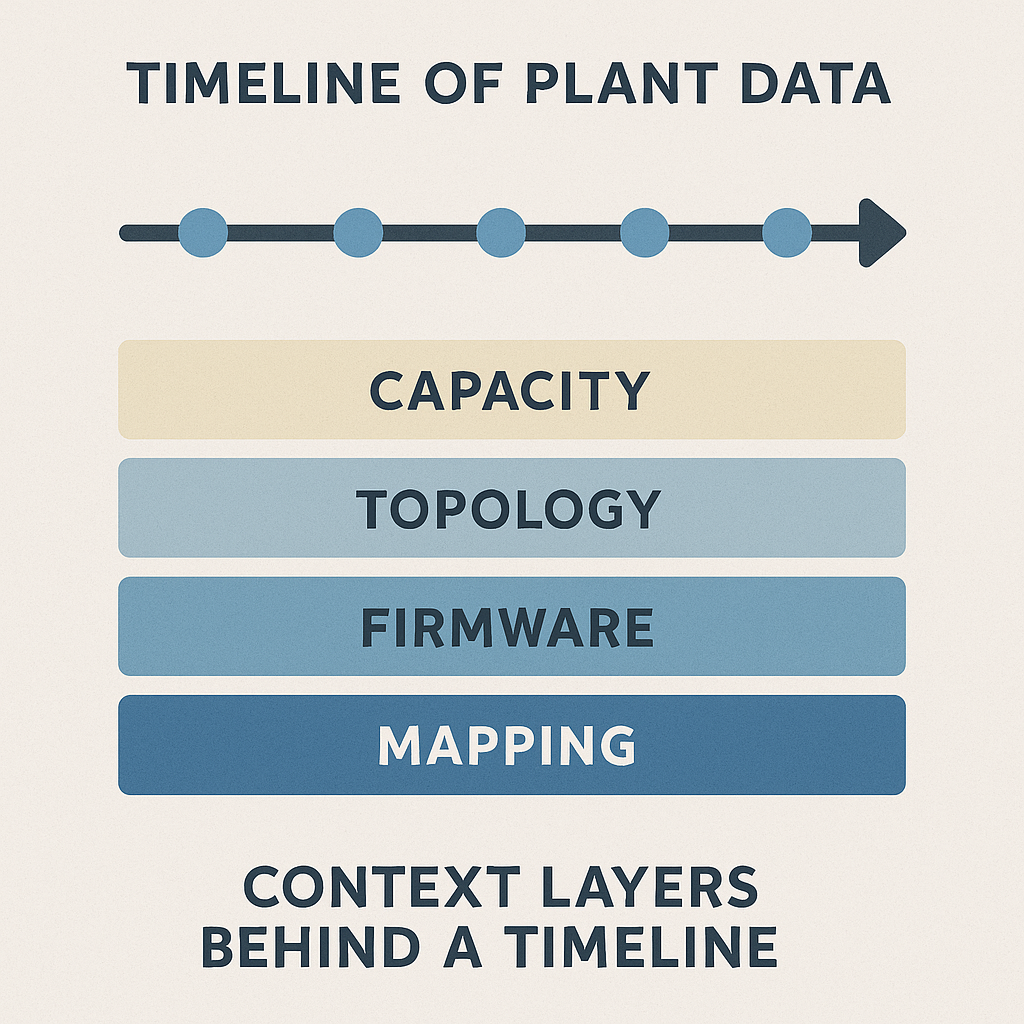
To do this correctly, analytics requires something monitoring rarely provides: the technical configuration that was valid at the time.
The Core Problem: Monitoring Reinterprets the Past With Today's Configuration
This is the silent failure mode across the industry.
Monitoring systems can "go back in time," but they do so using the plant as it exists today, not as it existed then.
If metadata has changed since:
- inverter replacements
- module swaps
- string reassignments
- MPPT topology adjustments
- firmware updates
- capacity corrections
- sensor recalibration
- timezone adjustments
...then the KPIs they compute today for historical days are no longer accurate.
This is why operators see:
- shifting PR
- inconsistent baselines
- KPI drift
- energy sums that change retroactively
- missing or new alarms in the past
- benchmarking instability
Monitoring systems are not wrong. They are simply using the only context they have: the present one.
To understand the operational consequences of this drift, see KPI Drift in Solar Assets: The Silent Risk No Monitoring System Warns You About.
Why Analytics Requires Historical Context
Analytics must use:
- the correct inverter list
- the correct string-to-MPPT mapping
- the correct transformer configuration
- the correct DC/AC capacity
- the correct firmware behavior
- the correct sensor scaling
- the correct naming conventions
Analytics cannot explain the past unless it sees the past in its own terms.
This distinction is the foundation for understanding:
- why documentation gaps matter Solar Asset Documentation Is Broken - Here's What Operators Can Do Today
- why metadata inconsistencies spread (Coming soon The Silent Spread of Inconsistent Technical Information)
- why reproducibility is hard (Coming soon Reproducibility in Solar Analytics)
- why portfolio growth exposes weaknesses How Portfolio Growth Exposes Hidden Weaknesses in Solar Data Management
The Short Version
Monitoring shows the present. Analytics explains the past.
Monitoring uses the current configuration. Analytics must use the historical configuration.
Monitoring is operational. Analytics is forensic.
Monitoring streams data forward. Analytics brings meaning backward.
Why This Distinction Matters Now
As portfolios grow, this difference becomes critical. The larger the fleet, the more:
- undocumented changes accumulate
- baselines drift
- naming diverges
- metadata fragments across providers
- investigations slow down
Most operational pain points are symptoms of this single misunderstanding.
Monitoring and analytics are not two views of the same system. They are two systems with different responsibilities.
This blog series explores every operational consequence of that gap - starting with
- Why Technical Plant Information Is the Missing Link in Solar Operations
- KPI Drift in Solar Assets
- Reproducibility in Solar Analytics (coming soon)